Pages

Showing posts with label Vegetable Gardening. Show all posts

2/12/2015

Seed Kits


Been piddling around with the idea of making a seed kit for a while now, and finally after having recently purchasing a seed kit for my mother-in-law as a gift, I finally bit the bullet and made on of my own. Despite hours of searching, I just couldn't find a kit that was exactly what I wanted.

The thing that bothered me about the seeds kits I saw online was that they usually included varieties that only grew well up north. They weren't packed with the hot humid summers and somewhat mild winters of Alabama in mind (no great overwintering plant varieties).  They weren't selected with the 4-season harvest garden in mind (little Elliot Coleman inspiration there). And either the kits were low variety count or else huge survival seed vault kits. Don't get me wrong, you can grow a pretty awesome garden with this kit, and you can save the seeds for a long time, but the intent here is to start a perpetual garden with a fairly large variety of seeds but low volume of each seed type for a fairly average sized garden. I DID want to follow the survival seed mantra of long term seed storage though, simply because every time I've ever bought a pack of seeds in the past, I've never planted them all, so if it comes in packaging that offers long term storage, then GREAT!.

Anyhow, this kit is over 20 varieties open-pollenated  heirloom veggies and herbs that will grow well in most areas of the USA, so check it out and see what you think. They're packaged in used cigar boxes (just love cigar boxes), so would make a cute gift. The individual seed packs are packed in paper then collectively packed in a double Mylar bag to make it moisture and light proof, then a desiccant is packed in each bag to keep moisture levels low enough for freezing, thus you can achieve much longer seed storage.

Anyhow, I'm excited. Check it out and let me know what you think. Opened a new store on big cartel: http://southerngreenliving.bigcartel.com/


5/24/2014

What to do with Garlic Scapes

This is our first year to grow a large planting of hard neck garlic (about 12 lbs worth). We plan to harvest all this garlic and replant it all to expand our supply. In the name of increased productivity, the garlic scapes (flower bulb) had to be cut off yesterday to prevent them zapping the bulbs. Virtually all of our garlic had produced scapes by the time we cut them (Music, Chesnock Red, and Inchillium Red). I honestly would like to see them bloom, but tough luck. Note: soft neck garlic, like you normally buy at the grocery store, doesn't normally make a flower bulb and basically is a clone. This flower allows the hard neck to cross pollinate and produce hybrid offspring from the seed garlic made within the flower bulb. Garlic scapes are sort of like eating the chives from onions + mild garlic flavor.
Garlic scapes on hard neck garlic
About a year ago, we travelled to Asheville, NC and stopped at a farmers co-op and had a breakfast biscuit. That was the most heavenly biscuit I ever ate. I have a thing about good biscuits, and this was one the best. Little did I know they'd put garlic scapes in it. I didn't even know what a garlic scape was before then, but I was bound and determined duplicate that biscuit (which has resulted in coutless failed attempts). If I ever do properly duplicate it, I promise to post a recipe.
Garlic Scape Cheddar Biscuits
Anyhow, now I have 2.5 lbs of scapes grown from 12 lbs of garlic (lots of scapes right?), so did my research on what I can do with all these rascals.

STORAGE OPTIONS:
  • Fresh: Store fresh in a flower vase for looks until you're ready to eat (might not want to store them this way for too long though)
  • Refrigerate: Store fresh in fridge for about a month.
  • Freeze: Food process or just blanche then freeze. Note: I like to make it into an pesto and then freeze it. It's very garlicky but not so much so that you can't enjoy it. Honestly, I still like traditional basil pesto better, but it is still really good, particularly if you're looking for creative uses for it b/c of the quantity you have (see recipe below).
  • Pickle: Can them in vinegar brine like you would cucumbers
  • Dehydrate: Food process, or finely dice then dehydrate to make a garlic spice. Mortar and pestle or crumble in hands afterwords to get a finer consistency. If you make it very fine, you can make a blend (salt, dried garlic spice, etc..) otherwise it will be more of a chive spice consistency
  • Maybe others, who knows'
VARIOUS USES:

Garlic Scape Pesto
~1 cup grated Parmesan or Tallegio cheese
~1-2 fresh lime/lemon juice + zest (or about 3 Tbsp)
~1/2 lb. garlic scapes - originally I weighed out a pound's worth but my giant food processor started filling up at what I'd estimate was half of that. And I quickly realized that was PLENTY of pesto. So I mostly just size it by the size it takes to fill up my food processor before processing. Chop it up and it goes down to about the half-way mark. Then add cheese, nuts, peas, and salt. Blend. Then add oil and blend (thus all the approximate marks).
~1/2 cup olive oil (however much it takes to get the consistency right)
~1 cup of toasted pine nuts, almonds, pecans, or walnuts- I prefer pine nuts but they are pricey. Once my pecan trees start making nuts, I'll probably just start using that in most recipes calling for nuts.
~1 cup of steamed English peas - this just dilutes the garlic-ness a bit and also gives it a good consistency. Can't really taste the peas.
~1/4 cup of fresh basil (if you have it, if not, no biggie) - when I made mine, I had garlic scapes but only tiny basil plants, so I went and nipped a few to add in
Salt to taste


Note: If you plant to eat it soon, just put it in a tall jar and top off with olive oil, then put a top on it to prevent oxidation. Or you can freeze it but be sure to get rid of all the air in the ziplock bag. Previously frozen pesto has a milder garlic taste. Can serve over toasted bruschetta or pasta with a side of grilled red bell pepper and/or steamed broccoli
Garlic Scape Pesto

Scapes as a Substitute for Garlic
Use them like garlic, as an aromatic in a wide variety of recipes. Scapes lose a lot of their bite when sautéed, more so than garlic cloves, so use at least three or four times as much scape-age as you would clove-age.


Scapes In Stir Fry
Scapes are popular in Asian dishes anyhow. Use in place of scallions or chives. Really you can use them in place of scallions or chives in any recipe, just about.
Asian Stir Fry with Garlic Scapes

Grilled Scapes as a Substute for Asparagus
Another great, and very different, way to showcase scapes is to grill them, tossed with a little olive oil, salt, and pepper, over direct heat for about two minutes. Flip them once, halfway through, and finish with an extra sprinkle of flaky salt and maybe a bit of lemon juice and zest. They'll be charred in spots and just soft enough, and their flavor will have sweetened and mellowed dramatically. Grilled scapes are surprisingly reminiscent of asparagus, and surprisingly different from raw scapes.
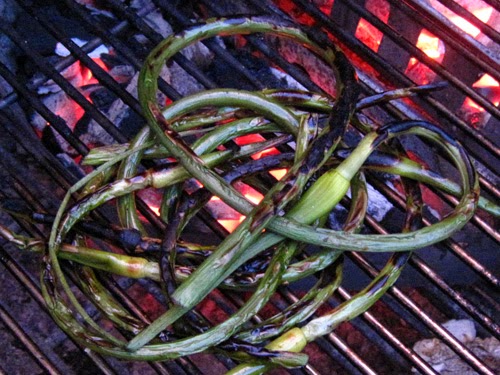
Grilled Scapes - Served Like Asparagus

Roasted Garlic Scapes
Take the scapes and put them in a lightly oiled roasting pan, top with salt (kosher or sea salt works best). Put the loaded and covered pan in a hot (425°F) oven for 30 to 45 minutes or until they are beginning to turn brown. serve as a side or main dish. Tastes like roasted garlic but creamier. This is also good drizzled with a light cheese sauce.


Sauted Scapes
Just tonight I boiled then sauted fresh beets in balsamic then tossed in some diced scallions at the last second. I usually just leave it with beets and balsamic but the scapes were a great mild garlic addition.


Scape Quiche
Or could just as easily just include them in an omlet
Garlic Scape Quiche

Garlic Scape Mashed Potatoes
Only add a little, then taste. This stuff's weird how you sometimes need a lot to equal a garlic clove and other times not. So best to add too little than too much.

In Flower Arrangement
Weird but cool, plus they're pretty to look at up until you EAT them.

Garlic Scape Flower Arrangement
Or let let them bloom
Garlic Flowers

Garlic Scape Vinegar
1 cup of white or rice vinegar with 1-2 fresh bruised green scapes. Let infuse 10 days for max flavor. Can replace scapes to keep pretty green color going. This could just as easily end being pickled scapes as well. Just cram more scapes in. Then you're primary eating the scapes vs the flavored vinegar.
Garlic Scape Flavored Vinegar

4/13/2014

Bean Planting + April Farm Activity

The strawberries and garlic (and weeds) are growing with a vengeance.

Our kind neighbor, with a tractor, tilled up about an acre for us without us even asking. So we had to kick butt and get something planted. Having not planned what best to grow, since we're basically farming from afar, we decided to do soil enriching beans and peas. We got varieties suitable for picking dry and growing in bush form since that's likely what will happen and we're not putting in trellis'. Hopefully we'll get at least a couple of fresh batches.

Next year we're DEFINATELY getting an earthway seeder.


We planted the following from Massey Mercantile:
  • Pink-Eye Purple-Hull Cow Peas: 49 days.  Heavy yields. Good disease resistance.
  • Zipper Cream Cow Peas: 75 days. Good yields of light colored peas. String acts like a zipper to make for easy shelling. AKA southern peas.
  • Ford Hook Bush Limas: 70 days. AAS Winner. Finest + largest butter / lima bean. Best yielder.
  • Speckled Red Bush Limas: 76 days. Pretty seed. Grows well in hot weather. Very productive.
  • Contender Green Bush Beans: 55 days. Extremely early + prolific. Long round oval pods. Resistant to mosaic + powdery mildew.
  • Roma II Green Bush Beans: 58 days. Broad flat pods. Very tasty fresh. Disease resistant.  
Might I saw it's shocking what a difference seed cost is when you buy in bulk. In my lack of planning I originally bought all these seeds in 1/4 lb quantities thinking it would be enough. I changed that out for a pound each and it ended up being less than twice as much. 4x the seed for about 1.5x the cost. Weird.


Native American Legend of the Three Sisters


I'm planting this garden and writing this post for my two sweet sisters for National Sibling Appreciation day. The Native American legend of the Three Sisters vary between tribes, but this particular story is from Lois Thomas of Cornwall Island found in "Indian Legends of Eastern Canada".

Three Sisters Garden - Corn, Beans, Squash

The Three Sisters Legend

A long time ago there were three sisters who lived together in a field. These sisters were quite different from one another in their size and way of dressing. The little sister was so young that she could only crawl at first, and she was dressed in green. The second sister wore a bright yellow dress, and she had a way of running off by herself when the sun shone and the soft wind blew in her face. The third was the eldest sister, standing always very straight and tall above the other sisters and trying to protect them. She wore a pale green shawl, and she had long, yellow hair that tossed about her head in the breeze. There was one way the sisters were all alike, though. They loved each other dearly, and they always stayed together. This made them very strong. One day a stranger came to the field of the Three Sisters - a Mohawk boy. He talked to the birds and other animals - this caught the attention of the three sisters. Late that summer, the youngest and smallest sister disappeared. Her sisters were sad. Again the Mohawk boy came to the field to gather reeds at the water's edge. The two sisters who were left watched his moccasin trail, and that night the second sister - the one in the yellow dress - disappeared as well. Now the Elder Sister was the only one left. She continued to stand tall in her field. When the Mohawk boy saw that she missed her sisters, he brought them all back together and they became stronger together, again.


The Iroquois Legend of the Three Sisters

Erney, Diana. 1996. Long live the Three Sisters. Organic Gardening. November. p. 37-40.
The term “Three Sisters” emerged from the Iroquois creation myth. It was said that the earth began when “Sky Woman” who lived in the upper world peered through a hole in the sky and fell through to an endless sea. The animals saw her coming, so they took the soil from the bottom of the sea and spread it onto the back of a giant turtle to provide a safe place for her to land. This “Turtle Island” is now what we call North America. Sky woman had become pregnant before she fell. When she landed, she gave birth to a daughter. When the daughter grew into a young woman, she also became pregnant (by the West wind). She died while giving birth to twin boys. Sky Woman buried her daughter in the “new earth.” From her grave grew three sacred plants—corn, beans, and squash. These plants provided food for her sons, and later, for all of humanity. These special gifts ensured the survival of the Iroquois people. 

Three Sisters Garden

The Three Sisters Garden is a technique where corn, pole beans, and vining squash are all three grown together on a mound. The three benefit each other where the corn provides a pole for the bean to climb. The bean provides nitrogen for the other plants, and the squash shades the ground later in the season preventing other weed growth and the mound from getting too hot.

Source:
http://www.birdclan.org/threesisters.htm

3/25/2014

Easy care bag garden


These simple bag garden plans are from the book Starter Vegetable Gardens. It's a 3 year plan. This idea is pretty genius, I think, as it's minimal effort, really cheap, and creates 3 foot wide rows which I think are ideal.

What I like is that you buy a cheap $2 bag of top soil and grow some shallow rooted veggies for one year and end up with the weeds all smothered beneath without even digging. Stack several side by side and you end up withr a 3 foot wide garden row. Then cover the edges with hay to hide the bags.

Year 1 bag garden plan:

Year 2 bag garden plan:

Year 3 bag garden plan:

Pretty bag garden example (although it doesn't use the top soil bag):

With top soil bag:


3/09/2014

DIY Soil Block Maker

In his book, Four Seasons Harvest, Elliot Coleman suggests making soil blocks for starting seeds rather than using containers. Growing them this way ensures the roots don't circle the container. They reach the end of the block and stop. This makes it easier to transplants vegetables normally more sensitive to transplant (squash, pumpkins, etc..). Sounded like a plan to me: less transplant shock, less trash, less costs, less trips to the store... Johnny Seeds sells these soil block makers. Nice as they look, I just couldn't get past the price tag, so here's what I made. Took an Apple Shuffle box, butchered it a bit, added some nuts and bolts, and poof, soil block maker. Left the screw protruding a bit to make the seed hole on top of the soil block. You could easily add another nut or screw the screw in more to make the hole bigger.

DIY Soil Block Maker - From Apple Shuffle Box
Johnny Seeds Soil Block Maker
Soil Blocks
Elliot Coleman's Recipe:

  1. 2 Tbsp Green Sand
  2. 2 Tbsp Phosphate Rock
  3. 2 Tbsp Dried Blood
  4. 3 Qt Peat
  5. 1 Qt Perlite
  6. 3 Qt Compost
My Modified Recipe:

  1. 1 Part Compost
  2. 1 Part Dollar Tree Peat Moss / Vermiculite mix
  3. A little bit of organic fertilizer


7/14/2013

Garlic Overview + July Farm Activity

It's blueberry harvest time. We sprinkled some organic cotton seed meal for nitrogen slow release fertilizer on the blueberries while we harvested. Was a pitifully small harvest. The bushes are still tiny and they don't really look all that great right now either. Hopefully the fertilizer will spruce things up a bit. We're about to bush hog the property then we'll have a fresh load of hay to sprinkle around all the plants as well.


Although it's pretty late into summer, we planted some sprouted zinnias. Not sure if they'll have time to bloom and go back to seed again, but hopefully so. I'm hoping to establish a nice reseeding zinnia bed. The seed packs were on sale for 10 cents so bought 15 and gave it shot.

Got 5 Kiowa blackberry plants put in the ground, tied to 2 strand trellis fence, and hooked up to 1 gph drippers ($9 per plant).

Bought 3 new types of garlic ($12 / lb):

  • Georgian Fire (Porcelian hardneck). Some claim it to be among the hottest of garlics. Averages 5-8 cloves per bulb. Really looking forward to trying this one.
  • Siberian (Marbled purple stripe hard-neck). Originally from fishermen trading green leafy vegetables with poor peasants who grew root crops. Averages 5-9 plump cloves per bulb. Good mild flavor. Can make a very large bulb. Siberian is reported to have the highest concentration of allicin compared to other garlic varieties (in general, hardneck garlics have 3x more allicin than softnecks)
  • Inchelium Red (Artichoke softneck). Large bulbed vigorous strain with 4-5 layers of cloves (8-20 total cloves). Won top rated soft-neck in 1990 Rodale kitchen taste test. Was discovered on the Colville Indian Reservation in Inchelium, Washington. Mild lingering flavor with a tingle.  This is one we tried last year and it didn't do squat for us, but it's supposed to do well in our area and want to give it one more shot.

Other varieties we already had:

  • Chesnok Red  (Purple stripe hardneck)  This one grew best for us last season of about 8 different varieties tried).  It’s said that this is one of the best cooking garlics.  It is very flavorful, having won “best baking garlic” taste tests conducted by Rodale, Sunset Magazine, Martha Stewart and others. It holds its shape and retains flavor well when cooked.  It has large easy to peel cloves.  Originally from Shvelisi, Republic of Georgia.  Averages about 8 cloves per bulb with a fairly large bulb. Can handle some neglect (boo-ya).
  • Mother of Pearl (Silverskin softneck). Excellent keeping qualities. Pearly pink/purple blush in heads. Spicy for a softneck. A rare garlic. Didn't grow all that well for us in Alabama but it hung in there so we're going to keep trying with this puppy.
  • Martin's Heirloom  (Rocombole). Originated from the garlic farmer, Martin (who else?). It’s been grown in Wisconsin since the early 1980’s and the original source is unknown.  It doesn't grow all that great down in Alabama but holds on. In Wisconsin it's claimed to be a huge and beautiful garlic. Averages about 10 cloves.

Other Varieties we tried but that failed entirely (bummer). 

In the garlics favor, we didn't do everything we could to help the garlic. Although we did treat the garlic before planting and did add alfalfa pellets to the soil at the time of planting (although probably not enough), we never fertilized again, we didn't do a good job of deweeding at all (and there were really weeds everywhere) and it was a very, very wet winter and spring:
  • Simonetti (artichoke softneck). Bulb size is supposed to be large with good flavor. Up to 20 cloves. a standard Artichoke that is very mild, very white and very large. If you want large, mild garlics, this is one to try. It usually does well, but some years it doesn’t, especially if there is a very early, very hot spring/summer.
  • Inchelium Red (see description above)
  • Red Toch (artichoke softneck). Originates from Tochliavri, Republic of Georgia. Averages 7 cloves per bulb.
  • Purple Glazer (purple stripe hardneck). Supposedly this one really doesn't like competition from weeds (aha, this was probably our problem). Very good flavor. Originally known as Mchadidzhvari #1 from Republic of Georgia. Averages 10 cloves per bulb.

Varieties We Want to Try

  • Metechi (Marbled purple stripe). Big, strong and robust. Harvests in the middle-late part of the harvest season
  • Burgundy (Creole silverskin). Deep purple, uniform cloves, delightfully mid-mild taste in a bulb that grows well and stores long. Very hardy and harvests in mid-late season. Ajo Rojo is another Creole similar to Burgundy except that its color is more red than purple and a little stronger. Creole Red is a medium Creole but has only about five cloves per bulb, but they are larger cloves.
  • Music (porcelain hardneck) Good flavor, sweet & pungent, very hot raw. Italian variety brought to Canada by Al Music in 80's. Averages 5 huge cloves per bulb and very hardy.
  • Romanian Red
  • Georgian Crystal
  • Thermadrone
  • Asian Tempest
  • Bogadyr
  • Red Rezan
Here's a decent writeup on garlic growing in warmer climates. I have definitely noticed plants described one way up north grow COMPLETELY different here and since there's hardly any garlic farmers in the south, it's sort of a roll of the dice as to what you'll end up with.

7/07/2013

Harvested Gourmet Garlic


It was garlic harvest time this week. It was a warm winter and cool summer so pests and weeds were a plenty and we didn't do a great job de-weeding or fertilizing and our soil's very acidic, so we didn't really set ourselves up for success, but all in all it wasn't so bad. We harvested all the garlic varieties at once (I know you're not supposed to do that) and layed them out on screens (from old windows) to dry. The soil was wet when we dug it up (I know you're not supposed to do that either), but it's been raining cats and dogs for weeks and almost all the green leaves were brown so figured it was now or never. We had to dry the garlic indoors. Little strange having garlic drying all over the apartment. Anyhow, you dry the garlic with the stalks still in place (I think this draws the moisture out of the center of the cloves a little better). You can tell when the garlic's dry enough b/c the green in the stalk is now totally yellow and dry. Once fully dried, you cut off the stalks and roots & brush off any dirt (unless it's softneck garlic in which case you can braid it if you want). If you didn't let your garlic go too long in the soil, you should have plenty of dry skin and can pull off a layer to clean up the garlic a bit.

We started last fall with 2 lbs of Chesnok Red and a 1 lb mix of  Inchellium Red, Red Toch, Simonetti, Mother of Pearl, Purple Glazer, & Martin's Heirloom. The Chesnok Red seemed to have done the best (biggest cloves, weight increased the most, was still the greenest at harvest time).

When we planted the garlic, we put name tags in the ground but for some reason the rain washed away what we wrote (although we used Sharpies). We remembered where we planted the Martin's Heirloom, Mother of Pearl and Chesnok Red, but not the rest.

Upon digging up the garlic (carelessly) we damaged quite a few cloves. On the bright side, that meant we got to eat them! (the plan was to harvest all the garlic and replant it all to grow our supply). We gave away about a pound of it (to very helpful and kind neighbors).

Anyhow, here are the results:
--0.23 lbs Mother of Pearl
--0.09 lbs Unknown Red/Purple Garlic
--5.31 lbs Chesnok Red
--0.18 lbs Martin's Heirloom

So despite not knowing what the 0.09 lbs of unknown purple / red garlic is, it didn't do all the well anyhow considering we planted Inchellium Red, Red Toch, Simonetti, & Purple Glazer (the rest is accounted for).

Anyhow, the harvested and cut and dried garlic is all bagged up in brown paper bags being stored in a cool dry location until replanting time during the Autumnal Equinox (Sunday, Sept 22).

3/10/2013

Practical wild edible plants in abundance locally

You frequently hear about wild edible plants, you might have even gone through the trouble of reading up on some of them. What you might have noticed is most of them are plants you've never heard of before and/or seen in the wild before.

So what i wanted to know was which plants grow abundantly in my neck of the woods? Here's my list.

  • Wild Blackberries
  • Mulberry
  • Pecan - Nov - Dec
  • Muscadine
  • Wild Strawberry
  • Black Walnut
  • Hickory
  • Wild Onion
  • Dandelions - roots, leaves, and flower are edible. Can be harvested year round
  • White Oak Acorns - Sep - Oct
  • Cattails
  • Clovers
  • Dead Nettle
  • Sassafras
  • Daylily


2/22/2013

Organic Garden Strawberries

For the 1st time, we planted strawberries today. Dad found a door frame somebody threw out and gave it to us to use for a raised bed. It's surprisingly attractive, even more so than the store bought raised bed frames. Upon review, almost everything on our back patio was acquired for free and it's all rather nice stuff, too.

The recommendation is 25 plants for a family of 4, so we bought 18 plants. The important varieties grown in Alabama, according to Aces.edu, are Chandler, Douglas, Albritton, Sunrise, Cardinal, Earligrow, Earlibelle, Delite, & Allstar. However, these varieties are nowhere to be found at Lowes, so we went with the following:
  • 6 Sequoia - June Bearer. In mild climate, this tends to grow like an ever-bearing
  • 10 Ozarks - Ever-bearing
  • 2 Quinault - Ever-bearing

There are 2 general planting methods for strawberries: the matted row & the hill system.

The matted row system generally produces a larger quantity of smaller strawberries, encourages runners, and is best suited for strawberry varieties that create a lot of runners (usually june-bearing strawberries). This  method works better for home-grown strawberries where hand de-weeding is possible. This system suits itself to growing perennially as the system gets stronger each year (if it doesn't succumb to disease and pests).

The hill system generally produces fewer large strawberries, encourages the mother plant at the detriment of the runners, and is best suited for strawberry varieties that don't create many runners (usually ever-bearing types). This system responds well to a plastic mulch and is frequently used by commercial growers in Alabama who plant in fall and harvest then till under in spring. Strawberries, particularly in Alabama with it's warm and humid summers, are susceptible to disease and pest and thus might do better grown as an annual then as a perennial.

For pest control (from birds), you can paint stones like strawberries long before the berries arrive to train birds there isn't any fruit.


Organic fertilization can be accomplished with blood meal to raise nitrogen and bone meal to raise phosphorus  Applications should be made monthly between June and September.

Expected productivity for a matted row system (makes me wish I'd ordered Day-neutral):
  • June-bearing: .5 - 1 lb / ft row during 2nd & 3rd year
  • Ever-bearing: .25 - .5 lb / ft row during 2nd & 3rd year
  • Day-neutral: .25 - .75 lb / ft row during 1st year & .5 - 1.5 lb / ft row during 2nd & 3rd year

Here's a good article on companion planting borage with strawberries.

Since we have predominantly ever-bearing varieties, we went with the hill system spacing 18" X 4' then inter-planting with a mescalin salad mix. We kept all the blooms clipped to encourage plant growth over fruit growth for the 1st year with the hopes that next year we'll have a better crop. The grassy top layer was tilled under then the remaining raised bed was filled in with 4 ft3 of Organic Miracle Grow Garden Soil and 1 bag of Velvet Magic Mushroom Compost. That filled it up perfectly. Topped it off (as a mulch) with some leaves for additional compost material. Fingers crossed we'll grow some nice, healthy, organic strawberries and baby Simon will get some truly homemade strawberry baby food!

 
5/2014 Update: The plants we purchased in pots all thrived and the ones grown as crowns from a bad almost all died (or maybe ALL of them?). Anyhow, we only bought maybe 8 plants from pot total and after clipping flowers and letting the plant run, then clipping the runners as soon as they showed roots to start a new plant, we ended up with about 100 plants by fall (there were Dixie cup strawberry plants everywhere). During fall, we took all the Dixie cup strawberry plants up to our property, laid down landscape fabric, poked holes in it, and planted all the strawberries. Turns out that landscape fabric (the kind we bought) didn't do a thing to keep weeds at bay. All it did was keep the soil moist to HELP the weeds, but it must have helped the strawberries too b/c they looked great and they made the best strawberry fruit I ever had in my life (this was the first time we'd ever even grown them before). Oddly enough, you can pick a fruit that's soft and it's not bad, it's actually the best when it's soft. You just have to eat it as soon as you pick it, is all (not a problem for me). Anyhow, it was very exciting as we've had a lot of bad luck with almost everything we've planted so far. Our soil is pretty nutrient poor and very very sandy, but the strawberries did really well. They dont' show any signs of disease yet. I'm surprised how many plants it takes to get just a little bit of fruit though. Most of the plants look pretty full of fruit, but at any given point in time they're mostly still green, so you can walk over 100 plants and end up with about 1 lbs of red juicy fruit. So far, we've gotten about 3 lbs total out of our 100 plants. Maybe we did something, but honestly they all look healthy at productive. Granted, I think something or someone else is eating some of our fruit. I did see several picked and bitten off of fruit lying around upon the last harvest.

11/25/2012

What To Do With That Pumpkin

Bought a fair size pumpkin before Halloween and just getting aeround to "doing something with it". So cut it into quarters, removed pulp and seed, popped it into the oven on two roasting trays, and baked at 350F for a couple of hours (till it was soft with a fork). Removed skin then puree'd using an emersion blender, and vwa-la, I now have 24 cups of pumpkin mash (that's a lot of mash). My first thought, of course, was make pumpkin pie (good timing, 2 days after Thanksgiving), but this is enough for 12 pies, so I need alternate plans.

Thai Pumpkin Soup (except I leave out the sweet potato, tofu, and chickpeas and emulsify blend everything into a bisque)
Pumpkin Pancakes (except I add a bit more pumpkin, makes the pancakes more dense but more moist too)
Pumpkin Beer (if I were still making it, bad timing being pregnant and all, though)
Cajun Spiced Toasted Pumpkin Seeds
Pumpkin Hot Chocolate (haven't tried this yet, but fully intend too. Love me some homemade hot chocolate).


11/24/2012

Poor Man's Rain-Collection Barrel

This easy DIY rain collection barrel gives you a free source of chlorine-free water at the optimal temperature for plant growth plus an ideal place to periodically add fertilizer. Doesn't hurt that it's cheap and easy to build too. You can substitute something prettier, like an old wine barrel, but it will cost a little extra.

Click here for detailed instructions:
https://docs.google.com/file/d/0B2gdNar_rMtAMjQxNzUxYmItYjU1ZC00YzYzLTgwNjMtZjg1ODA2MjYxMzdk/edit?hl=en_US

10/28/2012

Gourmet Heirloom Garlic

The gourmet garlic we ordered from Salt River Garlic in Kentucky arrived today. Never tried gourmet heirloom garlic before, so looking forward to giving this stuff a try.

Our Purchase:
2 lb Chesnok Red
1 lb Sampler: Inchilium Red, Red Toch, Simonetti, Mother of Pearl, Purple Glazer, and Martin Heirloom.

The sampler came with 6 varieties, each with 1-3 full garlic bulbs (various sizes and clove counts). The 2 lb bag had about 20 bulbs. A little pricey at $18/lb, but that seems to be the going rate just about everywhere, online. Hopefully we can turn around and sell it ourselves, down the road.

See below for a description of each type garlic we bought:
  • Chesnok Red: Purple stripe hardneck, medium to extra large bulb, large cloves with reddish color on outer husk, wheat-sized bulbils, become sweet when baked, great for roasting, 9-10 cloves / bulb, good disease resistance, Salt River Garlic's favorite, rare
  • Inchelium Red: Softneck artichoke, originally found on a Colville, Washington reservation, won the best tasting softneck garlic award from the Rodale Institute, produces a range of bulb sizes, flat-shaped bulbs with splashes of purple on the wrappers, contains 9-16 cloves per bulb, stores about 7 months
  • Red Toch/Tochliavri: German softneck artichoke. Not too hot nor too mild but with a spicy bite. 12–18 cloves per bulb.
  • Simonetti: Mild softneck artichoke originating from the Repulic of Georgia. Large bulb size, and flavor is very nice, even raw. 12-20 cloves.
  • Mother of Pearl: Softneck culinary silverskin garlic. Tend to be smaller but stronger flavored than store bought.
  • Purple Glazer: Similar to red toch, in flavor. Wheat-sized bulbils. Good for roasting or eating raw. Very sweet.
  • Martin Heirloom: Hardneck culinary garlic. Tends to be smaller but stronger flavored than store bought. A very large topsetter with large bulbils. Here's the story on Martin's Heirloom as listed on forums.gardenweb.com:
I first bought it in 1982 or 1983 from Jung's Seed Co. It was the first and last time that I saw it. It was simply listed as "Topset Garlic", or something similar, and sold only as bulbils. Upon getting them home and reading the planting instructions, they were to be planted 4 to 5 inches deep. Whoops, that can't be right! I contacted Jung's to point out the error and it was due to failure to convert metric to English. It was supposed to be 4cm to 5cm! Therefore, anyone who bought a packet, and planted according to instructions, got nothing in return.

Now forward 20+ years and I've been growing it ever since. Thus far, nobody can find out what it originally was named or if it were merely a local landrace from somewhere. Information on where Jung's obtained it went up in smoke several years ago. Thus it's sort of a mystery as well.
It's a hardneck variety, possibly a German porcelain type, and with rather large bulbils. An old Bavarian friend told me that they used to use those large bulbils in cooking and making stock. Those bulbils will produce normal divided bulbs in a single season, and that's how we planted them for many years. Some years, we got a lot of small bulbs and other years had larger ones and always from bulbils. In recent years, we began planting back cloves instead and got really big bulbs. (Go back and read other threads about growing and harvest results for it.)

Overall, it's unlike any other garlic that I've grown. 

Martin

Good garlic webiste: http://www.filareefarm.com/
 

7/13/2012

Blueberry Variety Comparison

Bought these 35 beauties on clearance at Lowes for $3.50 each. They were super healthy looking. 16 Homebelle, 14 Premier, and 5 Powderblue blueberries. Despite the wonders of Subaru Forester cargo space, it's looking more and more like we need a truck, eh?
Day after purchase, we drove up to the property and started digging holes (well mostly the hubby dug holes, and I marked where and gathered mulch and organic material). Got as far as about 30 holes before bodies started giving out and severe weather arrived.

It certainly appears as if we're steering towards blueberries at this point. While we have a variety (sampling really) of many fruit trees and bushes, over half of all our plants are blueberries now, which is good since it seems to like our super acidic soil (4.7) better than anything else.

Wrote up a tally of the total varieties we now possess of blueberry (all Rabbitteye).
Variety# We HaveColorBerry
Per Lb
FirmFlavorVigorAvg Lbs Per AcreHarvestDescript
Premier17938281097811Late May, Early JuneOne of the best for fresh eating.
Home Belle1610?4335?8?9?3979June1955 Variety with soft fruit and seeds and fair quality.
Powder Blue6103369997491
Tift Blue4936199198247Late June, Early JulyOne of most popular
Climax2835210882857MayShort concentrated harvest.

1/15/2012

Pecan Trees


Pecan's are truly beautiful and utilitarian trees native to the Southeast. I've always dreamed of a home with a long winding driveway with a canopy of giant old pecan trees.

I've compiled a list of facts and tips regarding selecting the right pecan for low input scenarios. These varieties might have a tendency to alternately bear, have a thick shell, or have a low meat content, but in general are of good quality and highly resistant to scab and somewhat resistance to other pests. Commercial orchard varieties produce thin shelled, high meat content nuts, but are often highly susceptible to pest and disease without high input spray systems. This isn't practical for organic or home gardens, especially considering the size of these trees (over 100').

The list below is comprised of low-input, high-humidity, high disease & pest tolerant varieties.

NameStartedYrs to BearMeat %TypeNut SizeAlt Bearing RatioDetail
*AmlingAl853%IMed - Small--Most highly recommended by UGA.edu for home growing
*Elliot--7-954%IISmall.68This is a very popular, widely available, and pretty nut. Oct 6 harvest.
Excel--649%IILarge--Large nut but shell is thick/
*McMillanAl6-751%IIMedlowVigorous but unproven long term since it's fairly new to the scene. Oct 19 harvest.
Kanza--752%IIMed-Small.72Like Elliot in most ways except more cold hardy
Gloria Grande--7-9--IILargemedCold tolerant but suspecptible to aphids. Consistent yields (less of a tendency to alternately bear). Nov 9 harvest.
CarterMs or Al7-850%IILarge--Only OK scab resistance. Oct 18 harvest.
*GaffordAl7-850%IlowlowConsistent, good quality nut
*JenkinsAl7-854%ILarge--Susceptible to leaf spot. Oc 16 harvest.
Syrup MillAl747%I--lowExtremely vigorous tree. Oct 16 harvest
FarleyFlSlow53%IISmall-Medium--Good scab resistance. Moderate aphid resistance. Low/Moderate but consistenly productive.
CandyMs--47%IISmall--Prolific and early. Good scab and aphid resistance. Sept 25.
CurtisFl--54%IISmall--Very good scab and good aphid resistance. Ripens late.

Type I and II describe pollen shedding vs receiving habits, and it's typcially best to mix one type I & II to ensure cross pollination. Aces.edu gives better detail on which varities can cross pollinate eachoter. * indicates my personal favorites for my area in North Alabama.

When planting for home use, space trees 60'-80' in a 3' hole 1'-2' wide. Prune 1/3 of tree after planting bare root. Fill hole with water as filling with dirt to eliminate air pockets. Add 6" mulch layer. Keep well watered for first 2 years.

The best time to plant is during early winter while tree is dormant allowing penty of time for roots to establish themselves prior to warm weather arrival.

Fun little price/variety comparisons:
  • http://www.alabamapecangrowers.com/Members/nurserylistcarry.htm
  • Petals From The Past: (Jemison, AL); 205-646-0069; $30-$40
    Elliot, McMillan
    Amling, Gafford, Jackson, Jenkins, Syrup Mills
  • Dellwood Pecan Tree Nursery: (Foley, AL); 251-943-8693
  • Mayo Pecan Nursery: (Grand Bay, AL); 251-865-4126
  • Underwood Nursery: (Foley, AL); 251-943-8056
    Jenkins, McMillan, Carter,and Gafford
  • Aarons Farm: (Sumner, Ga); 888-652-7939
    Elliot
    1-2 ft $13
    2-3 ft $25
    3-4 ft $40
  • TyTy: (Ga); 888-811-9132
    Amling, Elliot, Gloria Grande (free shipping w/ phone orders)
    1-2 ft $20
    2-3 ft $30
    3-4 ft $40
  • B & B Pecan: (Fairhope, Al); (251) 928-9031
  • Bass Pecan: (Canton, Ms); 1-800-732-2671
    Elliot, Excel, Jackson, Kanza (container)
    3-4 ft $35
    4-6 ft $45
  • Lakeview Pecan: (NC);
    Gloria Grande, Syrup Mill ($5 shipping, $15 min)
    Seedlings $20
    1-5 ft $25
    5-6 ft $30
    6+ ft $35


References:

1/10/2012

Farmer's Market Ideas

Wild Flowers -- I know everyone's doing this, but it just makes your stand pretty and, generally speaking, just makes folks happier


Braided Garlic -- http://www.youtube.com/watch?v=G7Xyj82oO4g. Braided garlic's just pretty, plus, and my sister pointed out, it makes it where you're selling enough of it to actually make a few bucks.

Pickled Products -carrots, asparagus, pickles,... Sis said she had the best horseradish flavored pickled carrots at some fancy restaurant, so planning to give a stab at that one.

Juicing -- organic once we get our fruit trees producing enough, but until then, maybe just fellow farmer's market produce (which is mostly not organic)

Salsa -- Verde is my favorite but a couple of flavors wouldn't hurt

Sauerkraut - made this a couple times now, last time with whole peppercorns and whole fresh jalapenos. Added a nice flavor and heat.

Peach Butter - I've made this a few times already and it's soooooooooooo yummy.

Honey - Once we get it. This might not be right away though.

The theme here, in case you can't tell already, is stuff that's not ooberly perishable. Defeats the purpose of a farmer's market, I know, but it leaves room to sell fresh stuff too but still have other stuff on the table. That's what I like.